Typhoon season
Loveboat, TaipeiTyphoon season is the force that turns the summer’s journey across Taiwan into a reckoning with disaster, unequal vulnerability, and responsibility. Its floods are not merely dramatic weather: they destroy homes in Taitung, compel Mei-Hwa to leave the tour, and give the students a concrete purpose for their creative work. At the same time, the storm’s accumulating rain, darkness, and floodwater become part of the novel’s emotional language, surrounding moments of intimacy and uncertainty without diminishing the material losses experienced by affected families.
The Storm Becomes Visible
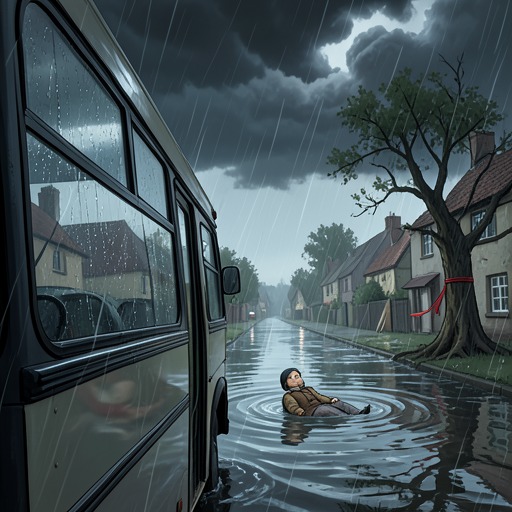
The typhoons intensify as the students travel by bus, rain sheeting against the windows and blurring the countryside. The tour passes a Puyuma village submerged in muddy water: only tin-roof peaks remain above the surface, while debris floats through what looks like a landscape emptied of life. An overturned rickshaw wheel spins in the water; dead fish show their silver undersides; a muddy doll lies with its hair and striped red, yellow, and green skirt fanned out around it. The details make the disaster legible through objects and losses rather than through a distant report.
When Debra asks whether anyone was hurt, the tour guide says no, and conversation resumes. That quick return to chatter marks a gap between witnessing destruction and absorbing its consequences. Later, the storm’s effects reach the students’ circle directly: Mei-Hwa’s home in Taitung has been hit, and her whole village is destroyed. Her parents and sisters are safe, but her family has lost everything—clothes, photographs, and furniture. She leaves the tour to go back and help her parents, turning a shared itinerary into a personal emergency.
Floodwater and Unequal Exposure
The disaster sharpens the students’ awareness of privilege. After a conversation about racism, Rick says they are privileged; the remark frames comfort not as an abstract quality but as something that can be felt against the losses around them. Ever recognizes a painful likeness between Mei-Hwa’s family and her own: both are shaped by the sacrifices and hardships of parents, yet Ever has treated those burdens as pressures to resist. The storm makes another family’s losses immediate while forcing her to reconsider the history carried by her own.
Ever recalls her father’s childhood poverty, his first impressions of American roads after growing up with dirt ones, and the care with which he once ate meat she had rejected so that food would not be wasted. She also remembers her parents’ difficulties in the United States, her mother selling her necklace to send Ever to Taiwan, and her father’s hopes for her future. That history comes into focus as she sits with Rick at the hot springs: the flood has not caused these family tensions, but Mei-Hwa’s loss helps Ever see them in a new light. The typhoon thus joins distant disaster to intimate recognition without making the two interchangeable.
Weather as Emotional Pressure
The storm recurs as a physical and emotional condition. Xavier crosses his arms over a box, and Ever wishes they could recover their former ease; their lost comfort feels as elusive as sunlight during typhoon season. The comparison places a relationship’s changed atmosphere within the same prolonged weather that shapes the tour: relief and clarity remain imaginable, but they are not immediately available.
A blackout gives the storm another kind of presence. Wind shakes the building, white paper lamps sway overhead, and rain accelerates against the windows before the lights flicker out and leave the room dark. The students answer with dismayed cries, and Sophie identifies the outage as a blackout. The moment is brief, but it makes the weather an active interruption to communal life rather than scenery outside it.
Floodwater also accompanies a quieter turn toward connection. On the last full day of the tour, Ever and Rick walk hand in hand through ankle-deep water at the hot springs resort, beneath dripping palm fronds and through bamboo. They have not kissed again since Rick’s letter, and the restraint gives their closeness the same sense of accumulated pressure as the surrounding water. The storm’s imagery therefore connects romance to the summer’s atmosphere, while the flood itself remains a real hazard that has displaced and impoverished families.
From Disaster to Collective Action
The students respond by making the performance and auction serve typhoon relief. Before the finale, Sophie announces that the proceeds will go to families in Taitung affected by the storm. She offers Xavier’s mural for auction as the final item, extending the fundraiser beyond the performance itself. The students’ art does not undo destroyed homes or restore lost possessions; it gives their gathering a practical destination and directs its proceeds toward people enduring the consequences.
Xavier’s mural gathers memories of the summer into an image of rivers meeting: Asian American children occupy the blue water, while black-haired families of different ages fill the gray. He calls it an analogy for the students. Its confluence offers a visual language for connection across distinct histories, and the auction makes that image part of the relief effort rather than leaving it only as a private artwork. Sophie later announces that the event has raised more than five hundred thousand New Taiwan dollars, equivalent in the narration to US $16,000, for typhoon relief.
The storm’s narrative significance lies in this movement from sight to response. First it appears through a drowned village observed from a tour bus; then its costs become personal through Mei-Hwa’s decision to return home; finally, it changes what the students’ performance is for. Typhoon season binds weather, place, and ethical attention together: floodwater interrupts the summer, exposes the limits of the travelers’ security, and helps redirect their talents toward families who have lost nearly everything.